About
Introduction to the Revised Code
What is Ethics?
Ethics is the study of what is right and wrong, good and bad. In a profession, ethics gives guidance on how members of the profession should act.
Ethics grow from the shared values and expectations within a group. Over time, members of a profession agree on what their professional practice looks like; these are called norms. [1] [2] When norms are written down and organized, they form the foundational ideas that become the values and principles, which are often expressed through a code of ethics. A code of ethics expresses the behaviors that a professional community agrees are appropriate and the outcomes that it strives to achieve.
What’s New?
The revised National Code of Ethics for Interpreters in Health Care brings years of professional practice, reflection, and growth together. It captures what interpreters have learned through experience and turns it into shared guidance. It guides interpreters toward desired outcomes by defining the values that shape our goals. Values and ethical principles guide the processes of critical thinking [3] and reflective practice.[4][5][6] In this way, the National Code of Ethics for Interpreters in Health Care supports interpreters in making thoughtful decisions that reflect both professional integrity and sound judgment.
The revised code:
-
Recognizes healthcare interpreting as a practice profession,
-
Presents the shared values and ethical principles of the profession, which guide decision making and allow flexibility to choose the optimal action in each specific context,
-
Emphasizes an outcome-based ethical approach,
-
Aligns with widely accepted values in healthcare.
Healthcare Interpreting as a Practice Profession
A practice profession is any type of service-based profession in which practitioners (for example, nurses, teachers, and therapists) must address and deal effectively with the complexities of the human condition, human communication, and human interaction
One aspect of a practice profession is its use of an outcomes-based approach to ethical reasoning. (Dean, n.d.)
Practice professionals “work in unique situations that are difficult to standardize.”[9]
Healthcare interpreting, as a practice profession, requires two major skill sets:
-
technical skills, such as vocabulary, grammar, memory recall, and pronunciation, for conversion, and
-
interpersonal social skills to manage dynamic interactional, intercultural settings.
Members of a practice profession use knowledge, experience, and ethical judgment (the process of evaluating and making decisions) to apply the values and principles defined in their code of ethics to individual situations. [10]
The National Code of Ethics for Interpreters in Health Care is a key part of what makes healthcare interpreting a practice profession. It gives practitioners of healthcare interpreting a shared ethical language to describe their decisions based on values. The ethical language in the National Code of Ethics for Interpreters in Health Care helps interpreters make informed decisions, reflect on their choices, discuss them with colleagues, and learn from experience. It encourages interpreters to be thoughtful and transparent about their thinking, recognizing that professional growth comes from both well-reasoned decisions and the lessons learned even when outcomes are not as expected.
How to Use The National Code of Ethics for Interpreters in Health Care
Before exploring the layout of the National Code of Ethics for Interpreters in Health Care, it is important to understand how it is meant to be used.
The National Code of Ethics for Interpreters in Health Care provides a clear structure of shared Values, Ethical Principles, and Standards of Practice, that lay the foundation for ethical decision-making. This structure creates consistency and direction while allowing interpreters to apply them with ethical flexibility. The flexibility lies in applying professional judgment to choose the optimal ethical actions depending on the circumstances of each encounter. It is not a list of rigid rules to be blindly obeyed. It emphasizes an outcome-based approach[11] to ethical decision making that focuses on the results of actions and how well those actions support the values and goals of the profession. [12]
Ethical flexibility is practiced through a process called context-based ethical reasoning,[13] which is the process of:
-
analyzing what is happening,
-
identifying who is involved,
-
considering the purpose of the encounter, and
-
choosing actions that reflect professional values and principles, and that are most likely to arrive at the best outcomes in that specific situation.
Context-based ethical reasoning recognizes that ethical behavior depends on responding to the specifics of each situation and that responsible action requires critical thinking and reflection.
In summary, the National Code of Ethics for Interpreters in Health Care offers a structure of shared ethical expectations, allowing interpreters to respond thoughtfully to the complexities of healthcare interactions.
How the National Code of Ethics for Interpreters in Health Care is Structured
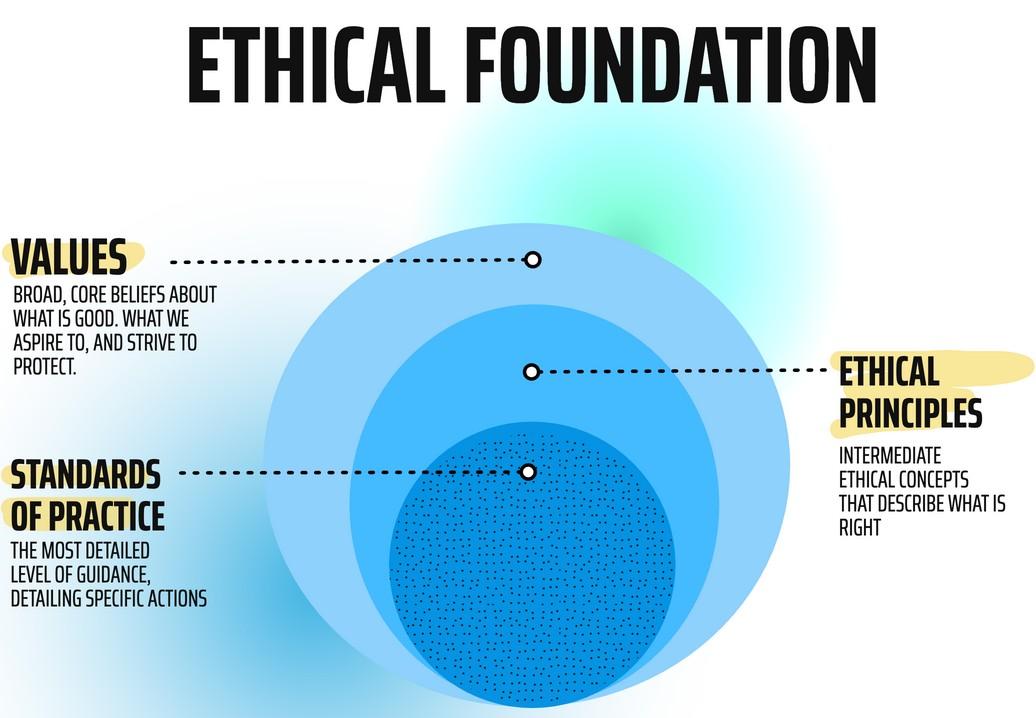
The National Code of Ethics for Interpreters in Health Care is structured from broad to specific: from Values to Ethical Principles to Standards of Practice.
-
Values are broad ethical concepts that express what matters most to our profession and define the goals we strive to achieve.
-
Ethical Principles are intermediate ethical concepts that provide more specific behavioral guidance describing the essential behaviors and responsibilities of healthcare interpreters about what is right and explain how the values are expressed in our profession.
- Standards of Practice are the most detailed level of guidance that show how to put the values and principles into practice.
-
Prompts: The National Code of Ethics for Interpreters in Health Care introduces questions called prompts that encourage ethical reasoning (thinking carefully about professional choices) and professional discussion. They can be used for critical thinking and reflective practice. Interpreters can use these questions to think critically, exploring possibilities, weighing choices, and considering which actions would support professional values and the desired outcomes in context. The prompt questions can also be used for reflective practice to analyze and learn from past encounters.
Examples: Examples show some specific ways the standards can be put into practice. In some cases the examples are broad enough to apply to all modalities. Other examples are specific to one modality. Click on the link to see additional examples under each standard. Examples will continue to be added.
Purpose of the National Code of Ethics for Interpreters in Health Care
The purpose of the National Code of Ethics for Interpreters in Health Care is to guide professional practice. It does not tell interpreters exactly what to do in every situation; it is not prescriptive. Instead, it offers a foundation for ethical judgment. It offers a structure of shared Values, Ethical Principles, and Standards of Practice that define what matters most in the profession.
It is important to note that the National Code of Ethics for Interpreters in Health Care is an ethical framework, but not a decision-making framework.[14] A decision-making framework provides a structured process for analyzing a situation, identifying ethical conflicts and selecting a course of action. The National Code of Ethics for Interpreters in Health Care does not describe a decision-making process. Rather, it gives interpreters the ethical foundation to rely on when they use any decision-making framework. The National Code of Ethics for Interpreters in Health Care provides the “what”, which are the Values and Principles that matter. Decision-making frameworks help interpreters apply the “how”, which is the process of reasoning (thinking carefully) through a situation.
Using the National Code of Ethics for Interpreters in Health Care in this way supports reflective practice. Reflection helps interpreters connect their daily decisions with the values that define the interpreting profession. When interpreters take time to think about experiences and learn from them they grow as professionals. Reflection turns experience into insight and strengthens context-based ethical reasoning over time.
The National Code of Ethics for Interpreters in Health Care defines what is expected of professional healthcare interpreters and builds trust in the profession.
History
More than twenty years ago, the National Council on Interpreting in Health Care (NCIHC) released two key documents: the National Code of Ethics for Interpreters in Health Care (2004) and the National Standards of Practice (2005). At that time, healthcare interpreting was still developing as a profession. Many interpreters had little or no formal training, and among the training programs that did exist, not enough placed sufficient emphasis on the importance of culture, ethics, and decision-making. As the provision of language services in health care expanded, the demand for qualified interpreters grew. These national core documents provided structure, shared values, and legitimacy for the profession.
How the Norms Were Identified and Established
State-based associations developed early documents outlining ethical principles and standards based on input from small groups of interpreters. The goal was to build shared agreement about what interpreters do and why, in order to establish clear expectations for the work interpreters do in healthcare. However, a proliferation of state-based norms, would not serve the profession well in the long run. The NCIHC recognized the need for a single nationally-vetted set of ethics and standards for the field. The NCIHC initiated the development of these national documents with funding from The California Endowment and later the DHHS[15] Office of Minority Health. The Standards, Training and Certification committee was created and started their work by reviewing existing codes of ethics and standards of practice from other sub-fields of interpreting both in the United States and abroad. In addition, focus groups were conducted in many parts of the United States in order to include the experiences of interpreters from many language groups and geographical regions. As the discussions were analyzed, the committee reached agreement on what defines effective interpreting practice. Draft documents were sent out with a survey for widespread review by working healthcare interpreters. The resulting agreements became professional norms, describing what is considered right and appropriate in healthcare interpreting.
The NCIHC formalized these agreed-upon norms into the National Code of Ethics for Interpreters in Health Care (2004) and the National Standards of Practice for Interpreters in Healthcare (2005). The Massachusetts Medical Interpreters Association[16] (MMIA) and the California Healthcare Interpreters Association (CHIA), two state-based health care interpreter associations that had already published standards at that time, signed a joint letter of support with NCIHC adopting these national documents.[17]
Why a Revision Is Needed
Since the publication of the National Code of Ethics for Interpreters in Health Care and National Standards of Practice for Interpreters in Healthcare, much has changed in healthcare interpreting. Language access is much more widespread, with interpreters more often considered part of the healthcare team. Many interpreters can now count decades of experience in the field, with a more sophisticated understanding of their role, their options and their impact. Remote interpreting, less common in the early 2000s, now accounts for a large percentage of the services provided.
Today, interpreters face additional challenges in their work environments. They practice in a wider variety of healthcare settings, and use new forms of communication technology. These changes raise ethical questions that require interpreters to analyze each situation and make informed choices about which actions will best support the desired outcomes of the encounter. This has led interpreters in healthcare to ask for clearer guidance on how to responsibly apply the profession’s ethical principles in keeping with the profession’s values.
The revised National Code of Ethics for Interpreters in Health Care empowers interpreters to use the Values, Principles, and Standards of Practice as a foundation for making thoughtful decisions during the encounter. Rather than being bound by strict rules, interpreters are encouraged to take a context and outcome-based approach.[18] An outcome-based approach means considering how each decision supports professional values and leads to the best possible results for everyone involved given the context. When interpreters use this approach, they not only strengthen their professional practice but also help build trust between patients and providers and in the healthcare system as a whole.
Acknowledgements
We extend our heartfelt appreciation to the interpreters and organizations who made this work possible: those who helped shape the original core documents more than twenty years ago, and those who, with honesty and generosity, shared their experiences to guide this revision. Your professionalism, openness, and thoughtful reflections on the realities of healthcare interpreting have informed every stage of this process. Your authenticity, past and present, continues to strengthen our shared understanding of what it means to practice ethically and with integrity.
We are also deeply grateful to the advisors, who took the time to review drafts, share feedback, and offer thoughtful suggestions. Your experience and insight helped make this revision clear, practical, and relevant.
A special note of gratitude goes to Robyn K. Dean, PhD for her time, insight, and generosity in sharing the most recent findings from her research on interpreting as a practice profession. Her work has informed and inspired this revision, particularly its emphasis on interpreting as a practice profession and on outcome-based ethical reasoning.
NCIHC Board
President Eliana Lobo
Vice-President Andy Schwieter
Treasurer Debbie Lesser
Secretary Yu Aloe Rioux
Director Kevin Cunningham
Director Rosemary Ford
Director Fabiola Munafo
Director Cynthia E. Roat
Director Yuliya Speroff
Director Indira Sultanic
Dean, R. K., & Pollard, R. Q. (2022). Improving interpreters’ normative ethics discourse by imparting principled reasoning through case analysis. Interpreting and Society: An Interdisciplinary Journal, 2(1), 55-72. https://doi.org/10.1177/27523810211068449 (Original work published 2022) ↩︎
The Editors of Encyclopaedia Britannica (2024, September 11). norm. Encyclopedia Britannica. https://www.britannica.com/topic/norm-society ↩︎
Critical thinking is the intellectually disciplined process of actively and skillfully conceptualizing, applying, analyzing, synthesizing, and/or evaluating information gathered from, or generated by, observation, experience, reflection, reasoning, or communication, as a guide to belief and action. (University of Louisville, n.d.) ↩︎
Reflective practice, also called critical reflection, is used by health professionals to review professional experiences to learn and improve self-awareness. (University of Louisville, n.d.) ↩︎
“Relective practice is the ability to reflect on one’s actions so as to engage in a process of continuous learning.” Schön, D. A. (1983). The reflective practitioner: How professionals think in action. Basic Books. ↩︎
“Active, persistent, and careful consideration of any belief or supposed form of knowledge in the light of the grounds that support it and the further conclusions to which it tends.” Dewey, J. (1933). How we think. D.C. Heath and Company. ↩︎
Critical thinking is the intellectually disciplined process of actively and skillfully conceptualizing, applying, analyzing, synthesizing, and/or evaluating information gathered from, or generated by, observation, experience, reflection, reasoning, or communication, as a guide to belief and action. (University of Louisville, n.d.) ↩︎
Reflective practice, also called critical reflection, is used by health professionals to review professional experiences to learn and improve self-awareness. (University of Louisville, n.d.) ↩︎
Skaaden, H. (2016). Professionalization and trust in public sector interpreting. International Journal of Language, Translation and Intercultural Communication, 5, 56–66. https://doi.org/10.12681/ijltic.10654 ↩︎
Dean, R. K., & Pollard, R. Q. (2018). The Demand Control Schema: Interpreting as a Practice Profession. CreateSpace Independent Publishing. Establishes healthcare interpreting as a practice profession and situates ethical decision-making as a reflective, outcome-based, and normative process. ↩︎
Known as the teleological approach ↩︎
Dean, R. K., & Pollard, R. Q. (2018). The Demand Control Schema: Interpreting as a Practice Profession. CreateSpace Independent Publishing. Establishes healthcare interpreting as a practice profession and situates ethical decision-making as a reflective, outcome-based, and normative process. ↩︎
Beauchamp, T. L., & Childress, J. F. (2019). Principles of Biomedical Ethics (8th ed.). Oxford University Press. Discusses the role of ethical principles (autonomy, beneficence, nonmaleficence, justice) as normative guides for professional conduct in healthcare. ↩︎
An example of an Ethical Decision-Making Model or Framework for Counselors can be found here, on page 2. ↩︎
Department of Health and Human Services (DHHS) ↩︎
In 2007 the MMIA became the International Medical Interpreter’s Association. ↩︎
Codes of Ethics and Standards of Practice - Joint letter of support CHIA MMIA NCIHC, September 2005 ↩︎
Dean, R. K., & Pollard, R. Q. (2022). Improving interpreters’ normative ethics discourse by imparting principled reasoning through case analysis. Interpreting and Society: An Interdisciplinary Journal, 2(1), 55-72. https://doi.org/10.1177/27523810211068449 (Original work published 2022) ↩︎